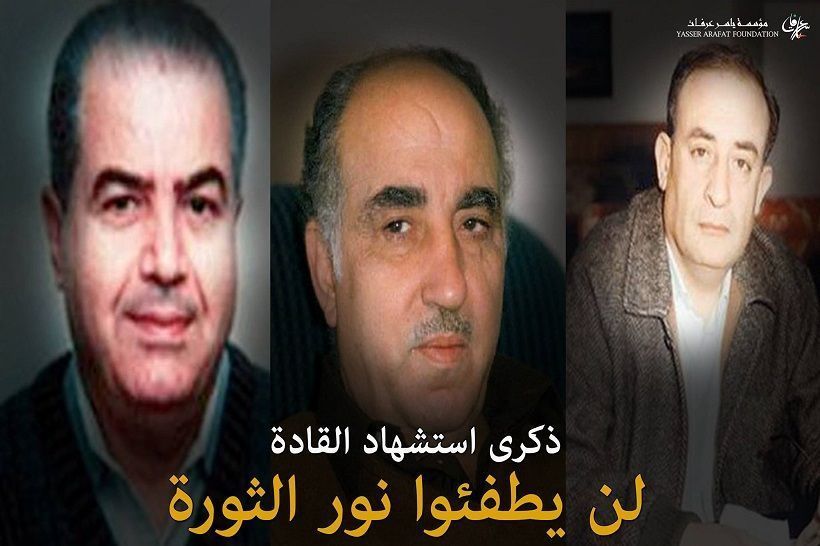
Today, January 14, 2026, marks the 35th anniversary of the assassination of three Palestinian leaders: Fatah Central Committee members Salah Khalaf (Abu Iyad), Hayel Abdel Hamid (Abu al-Houl), and the fighter Fakhri Ali Al-Omari (Abu Mohammad), one of Abu Iyad’s closest aides in the Unified Security Apparatus at the time.
On January 14, 1991, treacherous bullets claimed the lives of Abu Iyad—one of the most prominent founders of the Fatah movement—along with his comrades Abu al-Houl and Abu Mohammad, in the Tunisian capital. They were assassinated while holding a meeting at Hayel Abdel Hamid’s home in Carthage. With their loss, the Palestine Liberation Organization, the Palestinian revolution, and the Fatah movement were deprived of three of their most loyal and capable leaders, men whose lives were marked by sacrifice, dedication, and steadfast struggle against the Israeli occupation until their martyrdom.
Martyr leader Salah Khalaf (Abu Iyad) was born in Jaffa in 1933. He left for Egypt in 1951 to complete his university studies, and it was in Cairo that his path of struggle truly began. There, he met the martyr and founding president Yasser Arafat, then an engineering student. After completing his studies, Abu Iyad returned to Gaza in 1957 to work as a teacher, while secretly recruiting and organizing groups of fighters.
In 1959, Abu Iyad moved to Kuwait to work as a teacher. This period provided an opportunity for him and fellow leaders—Yasser Arafat, Khalil Al-Wazir, Khaled Al-Hassan, Salim Al-Za’noon, Farouk Al-Qaddoumi, and others in different countries, most notably Abu Yusuf Al-Najjar, Kamal Adwan, and President Mahmoud Abbas in Qatar—to unify their efforts and establish the Palestinian National Liberation Movement (Fatah), with the aim of restoring Palestinian rights and return to their homeland.
The founders of Fatah were determined to resist any attempt to subordinate the national movement to the control of any Arab government, believing that such oversight would hinder or slow their march toward
liberation. They began presenting their principles to the wider public through the magazine Filastinuna and established two parallel structures—one military and one political—between 1959 and 1964. This laid the foundation for a movement that would later become the largest Palestinian faction and the vanguard of the Palestinian national liberation struggle.
Hayel Abdel Hamid (Abu al-Houl) was born in Safad in occupied Palestine in 1937 and was displaced with his family to Syria in 1948. From an early age, he worked to organize Palestinian refugees in Syria, founding the “Arab Palestine Organization” in line with the prevailing pan-Arab nationalist currents. In 1960, the organization he established joined the Fatah movement.
Abu al-Houl was among the founders of Fatah in Germany and Austria, participated in establishing the movement in Cairo in 1964, and served as the organization’s secretary in Egypt. He later assumed
responsibility for Fatah’s security and intelligence alongside Abu Iyad, having previously served as Fatah’s representative in Egypt. After the assassination of Khalil Al-Wazir (Abu Jihad), he became commissioner of
the Occupied Territories apparatus, in addition to his security responsibilities, a role he maintained until his martyrdom.
Fakhri Ali Al-Omari (Abu Mohammad) was born in Jaffa in 1936. He studied in Gaza before traveling to Saudi Arabia for work. He grew up in a family deeply rooted in struggle; his father was an active fighter in
the 1936 revolt and a member of Sheikh Hassan Salameh’s group in the Jaffa region and surrounding villages.
In 1959, Abu Mohammad went to Saudi Arabia for work, maintaining close contact with Salah Khalaf, who had moved to Kuwait. When the idea of establishing Fatah took shape, Abu Mohammad was tasked with organizing and mobilizing Palestinian youth in support of the new movement in Saudi Arabia, and later in Kuwait, until he left his job to devote himself fully to preparing for Fatah’s second launch in 1967.
Martyr Fakhri Al-Omari rose to become a senior security official and served as the second-in-command of the Unified Security Apparatus led by Abu Iyad. He was assassinated after being struck by nearly thirty
bullets while attempting to apprehend the assassin, in a final effort to protect the martyr Abu Iyad.