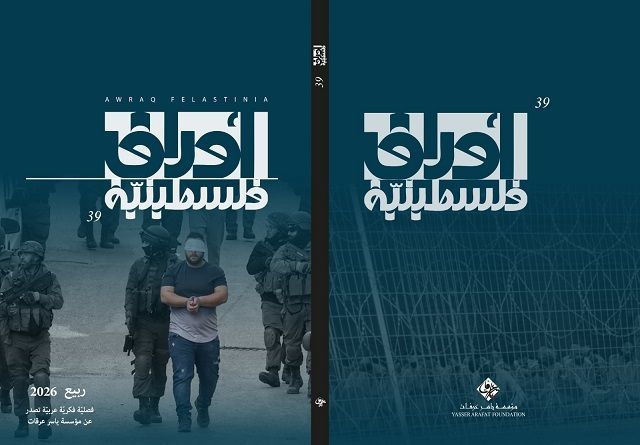
The Yasser Arafat Foundation released the thirty-ninth issue of its quarterly magazine, "Awraq Filistinia", on Wednesday, May 6, 2026, through its online platform.
The issue opens with an editorial by the foundation’s administration titled “Field and Political Resilience,” stressing the importance of strengthening social solidarity, expanding dialogue, unifying national efforts, and standing together in the face of the occupation. The editorial also calls for intensified regional and international engagement to revive the momentum of international recognition of the State of Palestine achieved last summer and to translate those recognitions into concrete measures capable of deterring the occupation.
The central feature of the issue is titled “The Prisoners’ Execution Law: Legalizing Killing and Codifying Crime.” Several writers approached the subject from different perspectives. Abdul Ghani Salameh examined the international position on the law permitting the execution of prisoners, while Issa Qaraqe argued that legislating the death penalty against Palestinian prisoners represents a transition “from silent extermination behind bars to open extermination under the protection of law.” Yasser Abu Bakr wrote an article titled “When Death Is Legalized: The Prisoners’ Execution Law as the Culmination of a Policy of Slow Extermination,” while Alaa Al-Badarneh discussed the legal implications of the occupation authorities’ approval of the law. Badi’a Zidan contributed an article titled “Literature of Freedom: The Chemistry of the Wall and the Semiotics of the Mask,” and Youssef Al-Shaib explored “Prisoners’ Cinema: When the Screen Becomes a Space for Reclaiming the Narrative.”
In the “Palestinian Papers” section, Alyan Al-Hindi wrote about “The New Middle East and the Future of Organizations Controlling States,” while Salah Abdel Raouf discussed “Towards an Arab Middle East.” Abdul Hakim Abu Jamos examined the occupation’s complete control over Area C and the dangers of reshaping Palestinian geography, while Tahseen Yaqeen presented a study titled “On Palestinian National Identity: When Time Came Full Circle as Farce.” Dr. Hussein Al-Deek contributed an article titled “War on Memory: How Palestinian Antiquities Are Becoming a Battlefield over History and Identity.”
The “Memory Papers” section featured a study by Aziz Al-Asa on Ahmad Abdel Rahman’s book I Lived in Arafat’s Era: Difficult Questions and Evidence-Based Answers, in addition to an unpublished manuscript by the late writer Ahmad Harb.
The “Cultural Papers” section opened with poet Khaled Jumaa’s review of Ali Abu Yassin’s book Gaza, the Milk of Pain: The Human History of a Stricken Land. Abdul Qader Yassin discussed “The Intellectual in the Intifada,” while Firas Obeid explored the characteristics of the post-Oslo Palestinian novel through the work of critic Tahseen Yaqeen. Radwa Abdel Qader also presented a study titled “Khalil Rizq Khalil: The Egyptian Working Class and the Palestinian Cause (1882–1952).”
The issue concludes with the “Foundation Papers” section, prepared by the media and public relations department, highlighting the foundation’s major activities and programs, including its permanent initiatives, partnerships with national institutions, and events organized by the Yasser Arafat Museum.
Palestinian Papers is a quarterly Arab intellectual publication that has transitioned from print to digital format. The issue is available online at:
https://yaf.ps/files/files/88.pdf