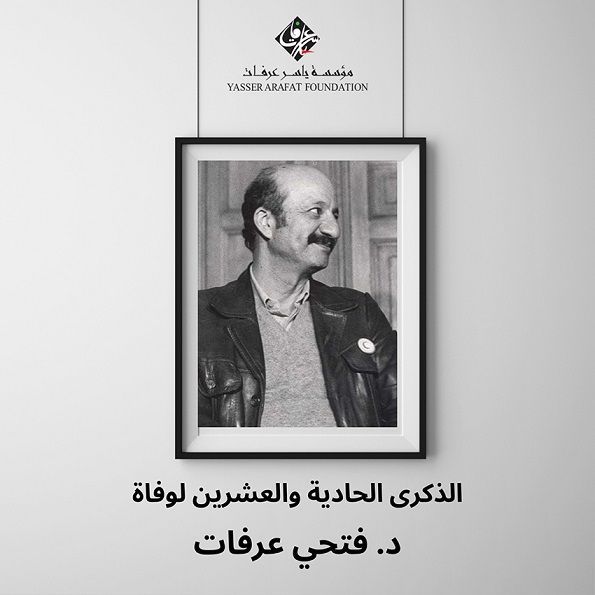
December 1, 2025 marks the twenty-first anniversary of the passing of Dr. Fathi Arafat, founder of the Palestinian Red Crescent Society—an extraordinary humanitarian who devoted his life to serving his people.
He passed away in Cairo on December 1, 2004, unaware that his brother and soulmate, Yasser Arafat, had preceded him in death just days earlier.
About Dr. Fathi Arafat
Dr. Fathi Arafat, whose full name was Abdul Fattah Abdul Raouf Dawood Arafat Al-Qudwa, was born in Jerusalem on January 1, 1933. He was the younger brother of Yasser Arafat. His mother, Zahwa Abu Al-Saud, passed away when he was only three months old. Following her death, her brother Salim Abu Al-Saud asked Fathi’s father, Abdul Raouf, to allow both Yasser and Fathi to live under his care along with his wife.
In 1937, Fathi and Yasser moved to Cairo accompanied by their uncle Raji Abu Al-Saud, after their other uncle, Salim, was arrested by the British occupation authorities. They traveled to reunite with their father and siblings.
Fathi completed his education in Egypt, earned his high school diploma, and went on to study medicine, graduating in 1962. Afterward, he moved to Kuwait to work as a physician.
His Humanitarian Journey
Dr. Fathi Arafat’s humanitarian struggle began with establishing the nucleus of medical services within the Fatah movement. Together with his brother, he soon realized that their work should not be limited to treating the wounded alone, but should extend to supporting their families and the wider Palestinian population—especially in refugee camps across Jordan, Syria, and Lebanon, as well as Palestinian communities throughout the Arab world.
From this vision emerged the idea of founding the Palestinian Red Crescent Society, an idea that matured in Dr. Fathi’s mind alongside his fellow founders, who laid the organization’s first cornerstone.
The initiative began modestly with the establishment of the Society’s first clinic in the Marka (Schneller) refugee camp on the outskirts of Amman, relying largely on community support and the efforts of young
camp residents.
By December 26, 1968—the official date of the Society’s founding—several clinics and health and social institutions were already operating on the ground, serving refugees in need. From that point onward, clinics, medical centers, and dispensaries spread across Palestinian communities wherever they existed, particularly in Lebanon, Syria, and Egypt.
Services expanded both in scale and quality, to the extent that the Society effectively assumed the role of ministries of health and social affairs, becoming a lifeline for refugee communities that depended on it
entirely for their medical and social needs.
The humanitarian and civilizational achievements of the Palestinian Red Crescent became inseparably associated with the name of Dr. Fathi Arafat. His identity merged with that of the Society itself; it became the focus of his life and concerns, often at the expense of his personal and family life. Developing and expanding the Society’s work was his lifelong mission.
Positions and Achievements
In 1972, Dr. Fathi Arafat became Honorary Secretary of the Executive Council of Arab Health Ministers.
In 1982, he was elected Vice President of the Council of Public Health Ministers within the Non-Aligned Movement.
In 2006, the Palestinian Red Crescent Society was officially recognized by the International Red Cross and Red Crescent Movement and the International Committee of the Red Cross.
Dr. Fathi Arafat was a member of Fatah’s Revolutionary Council, as well as the Palestinian National Council and the Central Council of the Palestine Liberation Organization.
Dr. Fathi Arafat passed away on December 1, 2004, after a long and painful struggle with illness that began three years earlier, during which he underwent surgery to remove part of his intestines.
“We build our state on civilized foundations so that our people and our children may enjoy what the peoples of the world enjoy.”