
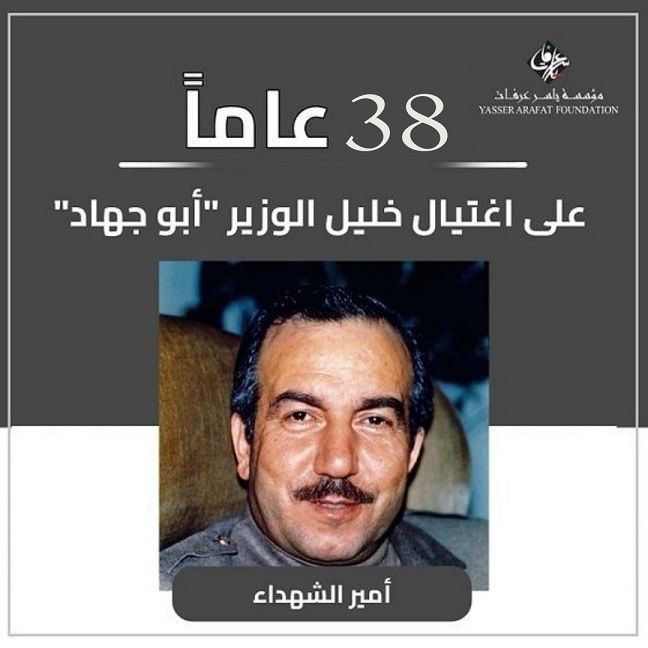
April 16, 2026 marks the 38th anniversary of the assassination of Khalil al-Wazir (Abu Jihad), deputy commander-in-chief of the Palestinian Revolution Forces and a key architect of the First Intifada. He was assassinated by Israel’s Mossad in his home in Tunisia in 1988.
According to reports and eyewitness accounts, Israeli commando units carried out a covert operation at dawn on April 16, 1988, landing on the Tunisian coast near Carthage. The mission involved elite forces supported by naval and aerial units, culminating in the assassination of Abu Jihad after breaching his residence. His bodyguard was also killed during the attack. Abu Jihad was reportedly working on documents related to the uprising at the time of the raid. His last known written phrase was: “No voice is louder than the voice of the Intifada.”
He was later buried in Damascus on April 20, 1988, in a large funeral procession. Despite restrictions in the occupied territories, widespread demonstrations and symbolic marches took place in his honor.
Born in 1935 in Ramla, Abu Jihad and his family were displaced in 1948 to Gaza. He later studied in Alexandria, and spent time in Saudi Arabia and Kuwait, where he met Yasser Arafat and co-founded Fatah in 1965. He went on to play a central role in building the movement’s military and organizational structure across Algeria, Syria, and other regions.
Abu Jihad held several senior positions within the Palestinian national movement, including member of the Palestinian National Council and the Central Council of the PLO, as well as deputy commander of the revolutionary forces. He is widely regarded as one of the main planners of the First Intifada.
After the 1982 Beirut siege, he continued leading military and organizational efforts from Tunisia, traveling frequently across Arab capitals to oversee Palestinian operations.
He was also associated with a number of major military operations attributed to the Palestinian armed struggle during the 1960s–1980s, and Israel held him responsible for several high-profile attacks before his assassination in 1988.